
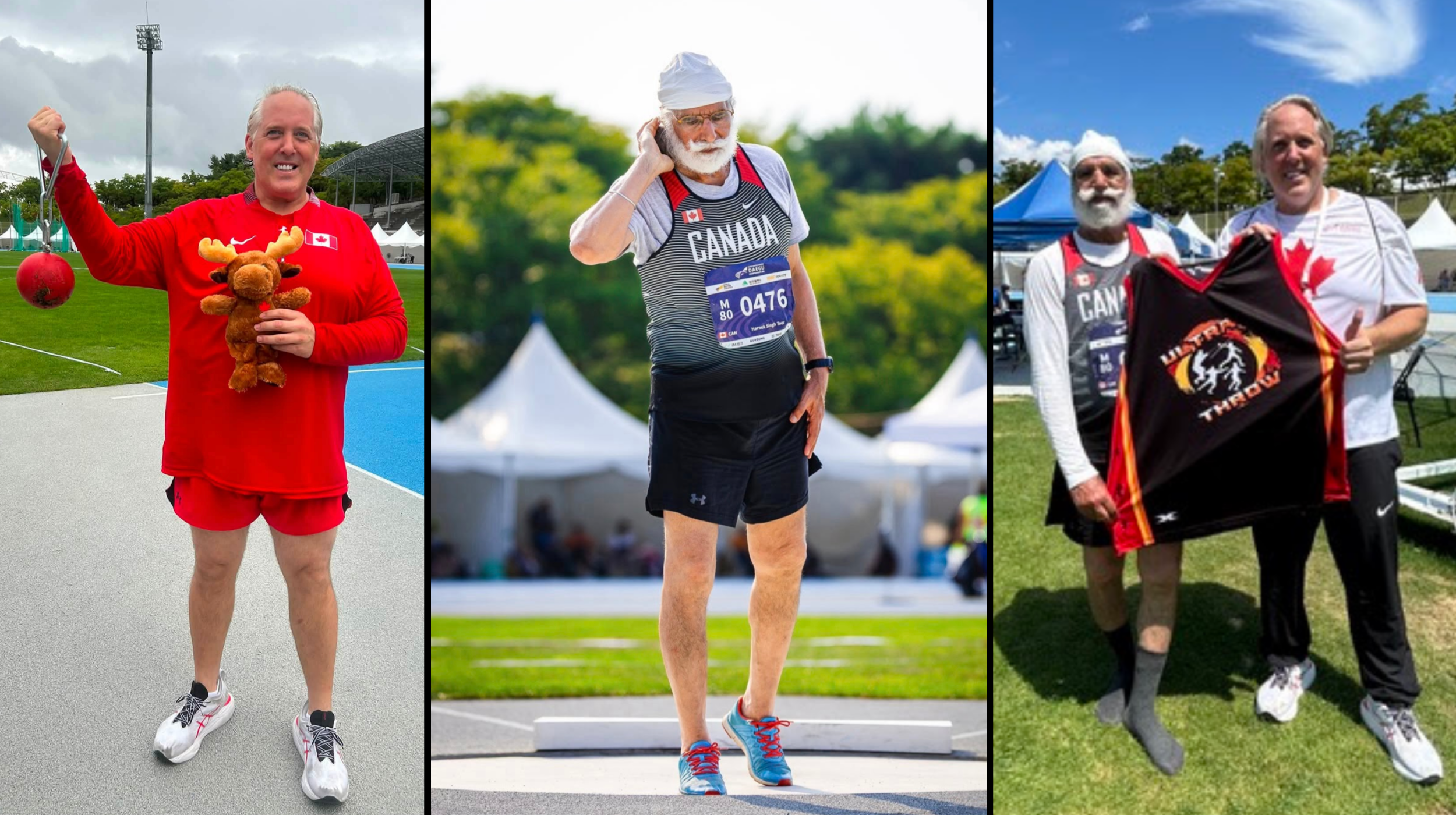
Two Ultra Throw athletes take on some of the world's best in Daegu, South Korea
Masters athletes from around the world gathered in Daegu, South Korea, from August 22 to September 3, 2026, for the World Masters Athletics Championships.
With close to 7500 athletes competing in more than 10,000 individual events, the championship was a massive international gathering of athletes from around the world. For two members of Ultra Throw Club, it was an opportunity to test themselves against some of the best Masters throwers on the international stage.
Shawn Stevens (M50–54) and Harnek Toor (M80–84) travelled to Daegu to compete across multiple throwing disciplines — fittingly representing the all-around spirit of Ultra Throw.
Strong performances on the world stage
Shawn competed in four individual throwing events as well as the Throws Pentathlon:
Hammer Throw: 34.73 m — 12th place
Discus Throw: 34.34 m — 9th place
Weight Throw: 13.55 m — 10th place
Shot Put: 9.97 m — 9th place
Throws Pentathlon: 2,610 points — 8th place
Harnek also embraced the full Ultra Throw challenge, competing in five events and returning home with three World Masters medals:
🥈 Javelin Throw: 29.52 m — Silver Medal
🥈 Shot Put: 10.68 m — Silver Medal
🥉 Hammer Throw: 35.15 m — Bronze Medal
Weight Throw: 13.00 m — 4th place
Throws Pentathlon: 2,422 points — 7th place
Both athletes faced strong international fields, including experienced Masters competitors from Europe, North America and beyond.
More than a competition
While the results were an important part of the experience, competing at a World Masters Athletics Championship provided something equally valuable: an opportunity to learn.
The combination of international travel, a very different climate, unfamiliar surroundings and the demands of competing in multiple events highlighted how much preparation happens before an athlete enters the throwing circle.
Daegu's heat and humidity presented an additional challenge. With temperatures producing a "feels like" factor of approximately 37–38°C, athletes arriving from cooler climates had to adapt quickly to conditions that could affect training, recovery, hydration and competition performance.
For Ultra Throw athletes preparing for future international competitions, several lessons stood out.
Lessons for future international competitions
1. Allow time to recover from air travel.
Long-distance travel can produce significant jet lag. Allowing three or four days to recover and adjust can make an important difference before competition begins.
2. Research the weather and prepare for it.
Weather conditions can have a major effect on an athlete's physiology and performance. Understanding the climate at the destination ahead of time allows athletes to plan hydration, clothing, training and recovery accordingly.
3. Plan your food before you leave.
Finding familiar and appropriate food in another country isn't always easy. Athletes should assess their options in advance and make plans to maintain their normal nutrition while avoiding unnecessary stomach upsets.
4. Keep training when possible.
If competition schedules allow, finding a suitable training facility after arrival can help athletes maintain their routine and avoid a significant break in training. Having access to appropriate throwing equipment is also important.
5. Learn the competition setup.
Before competition begins, athletes should familiarize themselves with the venue and locate the Team Manager, Technical Information Centre, Call Room, competition areas and concessions. Knowing where you need to be removes unnecessary stress on competition day.
6. Bring spare equipment.
Throwing shoes, gloves and other equipment accessories should have backups whenever possible. Equipment problems are the last thing an athlete needs to worry about at an international championship.
7. Bring your nutrition and supplements with you.
Rather than trying to find familiar nutrition products after arriving, plan ahead and bring what you need.
8. Prepare for language differences.
Language barriers can make simple tasks more complicated. Having translated information or small cards explaining important needs can be extremely useful.
9. Stay connected.
Reliable Wi-Fi and communication with teammates, team management and family back home can provide both practical and personal support. It's also important to think ahead about how emergencies or unexpected situations will be handled.
10. Take preparation seriously.
Perhaps the biggest lesson is that there is no substitute for preparation. International competition demands planning, discipline and focus.
As Harnek put it:
“Plan, prepare and fight WELL and PROPER. No one concedes an inch of their ground; one has to hold and win it with vigour.”
A productive championship — and plenty to build on
Overall, the 2026 World Masters Athletics Championships was a valuable and productive experience for Ultra Throw.
Not every result reflected what Shawn and Harnek had achieved in daily training, but that's also part of the learning that comes with competing at the highest level. Travel, weather, nutrition, unfamiliar surroundings and the pressures of international competition can all influence performance.
The lesson isn't to make excuses — it's to learn, adapt and prepare better next time.
As Masters athletes know, every competition provides another opportunity to learn something about your training, your preparation and yourself.
For Ultra Throw, having two club members take on the world stage — and bring home two silver medals and a bronze — is something worth celebrating.
And their experience in Daegu gives the rest of our athletes plenty to think about as we continue to throw farther, compete harder and prepare smarter.